email: truckingwrite@gmail.com

Showing posts with label Short. Show all posts

Saturday, May 10, 2025

Route 66


“If I do get stopped by the police”, I said to the motorcycle rental company’s representative handing me the Harley's documents, “Do I say, ‘haven’t you got anything better to do,’ like I would in England”? He looked at me over the top of his glasses. A lady tapping away at a computer behind the counter we stood at, laughed. It was, I admit, a pretty naff thing to come out with. The truth is I don't think I would say such a thing to any police officer, not now or at any time. Maybe I just wanted to suggest something that was pleasing to imagine.

Within days we were riding through ‘big country’, where, by the look of it, you could build anything you wanted, anywhere you liked. Isolated buildings appeared out of nowhere, then disappeared just as quickly, with no apparent connection to the land or locality. Some were new, bland, and with no obvious use, some were ugly, some run down, and some run down but simply beautiful. These were the abandoned motels that time and just about everything - apart from travellers on Route 66 – had forgotten. Rows of doors of different colours, some dislodged, some upright, but all with paint now flaking, stood amongst the crumbling, once whitewashed walls of these old buildings. Only a few decades before they would have stood proud and welcoming, with tall roadside signs shining brightly though the night.

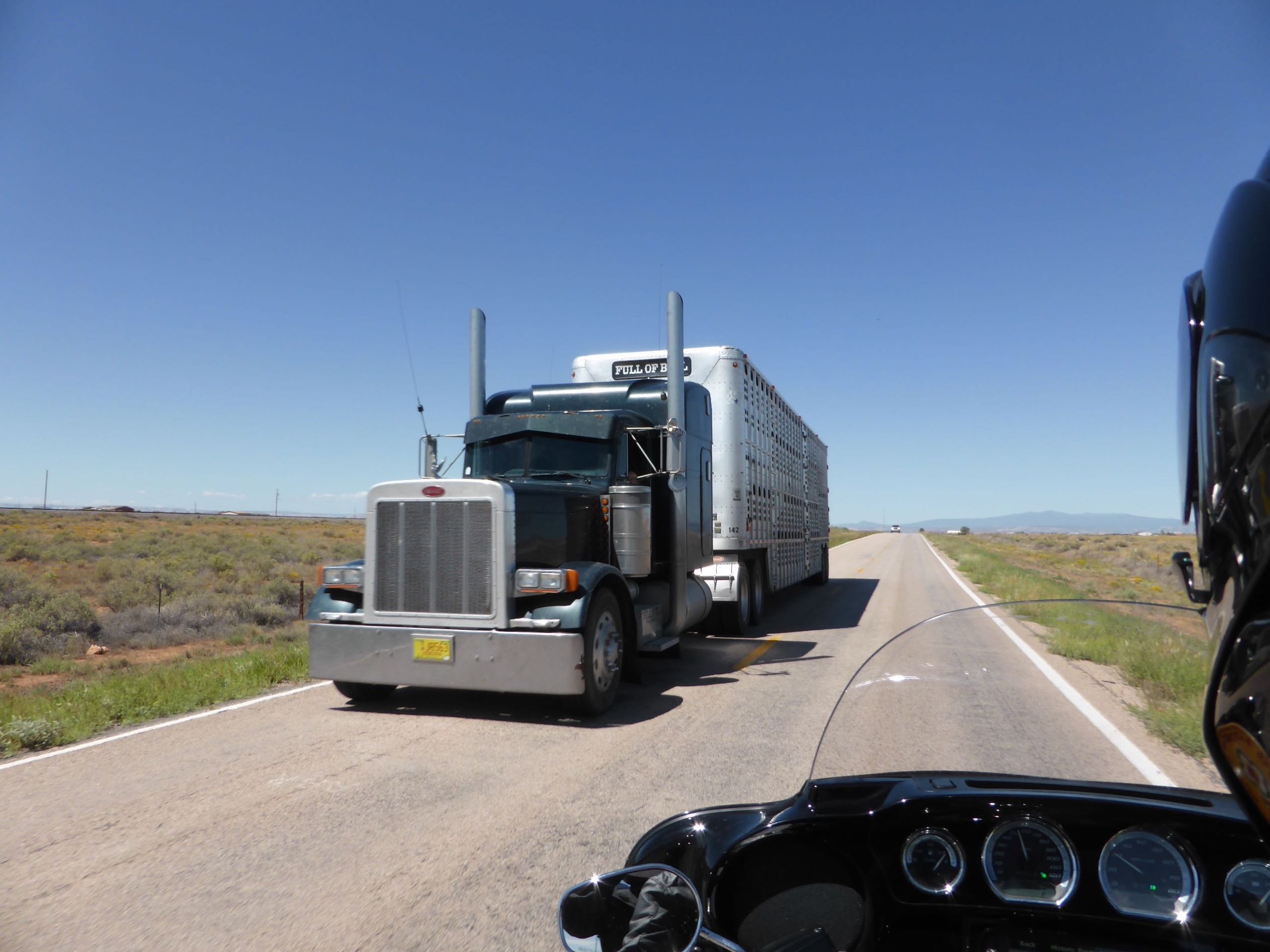
Our motorcycle thumped along doing what I wanted it to do – be American. But America had changed since my last visit. Cars had shrunk, in the same way ours back home had grown, so that now there seemed little difference in their size. And just like ours, they'd homogenised, so that no matter who the manufacturer, the same curvy, edgeless shape dominated. Trucks still had bonnets, but even they had softened. Gone were the enormous square grills, flat panels and split windscreens. The wild west had obviously been tamed, and it seemed the ‘hard’ rigs were now only to be found in the Australian outback. Big, functional and individual had become efficient, globalised, and normalised.

Well, almost. Somewhere along the Mother Road, we passed alongside a railway for several miles. Every couple of hundred metres or so a road crossed at ninety degrees to both our path and that of the track. So, every couple of hundred metres or so there was a stop line for us and to our right, a crossing for the track. As we rode along, changing down and slowing for each stop line, the crossings began to sound their bells. A train was approaching from behind, and for each crossing it was sounding its whistle. The clanging of the bells, the long, melodious note of the train's whistle, and the Harley's revving v-twin engine, made wonderful music - American music that went way back. The train eventually overtook us - two miles of wagons loaded with 40’ ship containers stacked two-high.

Wednesday, December 18, 2024

Jailhouse Rock - published Motorcycle Sport & Leisure


There has been a quarry of some sort on the Isle of Portland in Dorset since Roman times, a castle since the 16th Century, at least one prison since the 1800s, and one of the world’s largest manmade harbours since 1905. And since 2019, my Royal Enfield Classic 500 has been puffing up its slopes and visiting its cafes. Sticking out into the English Channel on the edge of Weymouth, Portland is a sloping strip of land about 4 miles long and 1.7 miles wide that’s linked to the mainland by a causeway forming part of Chesil Beach. The island is a place of heights and history filled with fantastic views and interest. It’s also wonderful for pottering about on a motorcycle, especially when the machine feels somehow in harmony with its surroundings.

Dorset is a beautiful county of rolling hills, wide vistas and sandstone cliffs, all guaranteeing that any ride along its coast to Portland, either from the east or west, will be a memorable one. Today, I’m coming in from the west, from Lyme Regis, which entails riding the B3157, one of the most spectacular roads in the whole of the country. There’s plenty to do in Lyme Regis, lots of coffee shops and eateries, and there’s parking for bikes, too: just drop into the Cobb Gate car park, the one with the small clock tower at the bottom of the town’s main street and go through the barrier on the left. But I’m just starting, so I ride straight on through, the Enfield popping its way down Broad Street before passing the clock tower and thumping its way up Church Street.

Once out of the town and through the sweeping bends of the A3052, I join the A35 and make my way towards Bridport and West Bay, from there heading along the glorious B3157. I ignore the Lemon Tree at Swyre and the Duck’s farm shop and café at Portesham, both great places to stop, and continue into the outskirts of Weymouth before following signs for Portland. We’re soon on the causeway, the Enfield and me, looking over to the left and to the Citadel and port below, places I’d soon be riding through, and forward to terraces rising on the island.

I’m using a Beeline Moto 1 mounted on the offside mirror arm, running it from a phone sitting in a tank mounted pouch. With power coming from an Optimizer adapter, it works well, ensuring there’s plenty of juice available for photos and messaging when I stop, while keeping the navigation going while I ride. I’ve set waypoints at the castle, a fortification built in 1540 by Henry VIII to defend against the Spanish and French, and the D-Day Museum, each one a chance for a bit of leg stretching.  I don’t visit either attraction, they’re both for another time, but there’s still plenty to see. An American Shernan tank and a Jeep stand outside the museum and two Mulberry Harbour caissons sit out on the water close by. In 1944, half a million troops and 144,000 vehicles departed Portland in just a few hours to take part in the D-Day landings.

The Enfield is quite at home amongst buildings of a bygone age and their flaking facades, despite its shining paintwork and bits of chrome, but we’re soon on the steep switchbacks through more recent housing and climbing to the Citadel and The Verne, a category C ‘Training Prison’ contained in what was once Portland’s main fortification. Built between 1857-1881, the Verne Citadel has served as barracks, battery, hospital, immigration removal centre and is now a prison. It also has the Jailhouse Café and spectacular views across the harbour. It’s a 30mph limit up through the housing, which is of little concern to the Enfield as it’s hardly able to reach such a speed before the road once again doubles back on itself and we’re cranked over, looking ahead for vehicles coming in the opposite direction, squeezing themselves between all the parked cars.

I sit down to a ‘Guvnor’ and latte, the former being a more than decent cooked breakfast, before walking out onto the café’s outdoor seating area and looking at the vista spread below. I can see the massive breakwater and Weymouth beyond, and the port where two RFA ships are moored abreast alongside the same jetty where cruise ships tie up when visiting.  These are support vessels that supply the Royal Navy’s new aircraft carriers, HMS Queen Elizabeth and HMS Prince of Wales. Not far off is Sir Tristram, an old RFA vessel that was badly damaged in the Falklands War and now serves as a training ship for special forces.

Our next stop is The Grove, another prison and another cafe, this one themed as an American diner. Unfortunately, Incline Road, a route that follows the coast around the eastern edge of the island, is not open to the public, so I point the Enfield up and out of Castletown on Easton Lane and continue south. I take a quick detour by turning left and into Verne Hill Road, New Ground and then Yates Road, simply because I can and they’re the little lanes the bike was made for, before rejoining the main route. Grove Road arrives soon after, and I make my way past the prison museum to the Jailhouse Diner, parking the Enfield on a triangle of tarmac opposite its entrance and below the tall prison wall.

A quick coffee and we’re off to the Bill, passing the disused lighthouse that’s now a bird observatory and homing in on the red and white striped tower that changes from distant landmark to imposing monument as we approach. Once there, I stop a while and gaze at the sea, wondering just how many wrecks there must be out there beneath the waves, before heading back down the western side of the island by following signs for Weymouth. (Portland Bill marks the eastern end of Lyme Bay, and its waters with their shallow reefs, sandbanks and tidal races have been the cause of many a shipwreck over the centuries.)

There’s evidence of quarrying all over the island and Portland stone has been used in some grand buildings, including St Paul’s cathedral, Buckingham Palace and the UN building in New York. My last stop on Portland is at the Tout quarry sculpture park on the way down Wide Street. There was obviously quite a bit to see, but I took a short walk into the area simply to look at the view down to Chesil Beach and the road off the island we’d soon be riding. And so it was that not long after leaving Tout quarry, I started on the first road with a speed limit over 40 mph since arriving on Portland - the causeway back to Weymouth. The road carried me away from a stone-built world of fortifications and lighthouses, of churches and prisons, and back to brick and modernity.

Returning to Lyme Regis, I’m travelling through Weymouth on the A354 and out to Broadwey, from where I turn left onto Church Street and follow Gould’s Hill, the B3159 to Weymouth Road. At Martinstown, I head for Hardy’s monument, an upturned spyglass shaped tower erected in 1840 in memory of Thomas Mastermann Hardy, Flag Captain of HMS Victory at the battle of Trafalgar, and then continue, doglegging across Portesham Road towards Little Bredy. This is Enfield Classic country, with lanes that cut along timeless hills and run through quant villages, past old churches and beside established country houses. Long Bredy and Litton Cheney come and go, and I’m back on the B3157 at Burton Bradstock.

I don’t stop in West Bay, although it’s a popular meeting place for motorcyclists, but instead pull up in Lyme Regis at the Cobb Gate car park. I can see Portland in the distance to the east, its tops rising to the Citadel before sloping down the Bill.     

Wednesday, February 7, 2024

Cave Man


Back in the 1970s, I worked as a fitter in a commercial vehicle workshop. It was a dirty job in a cold, oily space, where everything had to be finished yesterday, and where I often laboured through breaks. I rode to work each day on a XT500 and at night parked the bike in the street outside a grim little bedsit. I dreamt of a proper home, a garage, and multi-bike heaven.

And of a cave I could retreat into; my space, where everything would be done at my pace. It came, thankfully, eventually. Gradually. A flat sold for a small house that in turn became a larger one with a garage. Then retirement and a move to a place with enough land to build a workshop and garage, somewhere I can’t ever imagine moving from. The building is fully insulated with cavity walls and a galleried ceiling. There’s also a mezzanine deck used for storing bits – frames, tanks, tin wear etc - and Velux windows above a workshop area.

 I’ve owned and ridden motorcycles since my first moped at 16 years-of-age, back in a time that saw frustration with British manufacturing compete in equal measure with an admiration for Japanese engineering. It was about the same period that Scandinavian truck manufacturers were showing British lorry drivers just how good a wagon could be. Despite all that, I do have a soft spot for both British bikes and trucks, driven, it must be said, by rose tinted glasses and a hankering for lost youth. Now I spanner, service and tinker, sit at my desk and read manuals, look at maps plotting trips to bike meets and motor museums, and think about restoration projects either under way or planned. But whatever I do, I do it when I want to and because I want to.

In my garage there are bikes I’ve done, some I’m doing, and some awaiting attention. The Matchless G2 CSR was a project from a few years back, the G12 CSR, a recent recommission. There’s a Laverda 3C that’s on, and on, and on… going. I’ve also got quite a bit of AMC stuff waiting in the wings, and a TTR 600 and BMW 1150 that require a bit of light fiddling. And yes, I have ripped the ABS out of the BM. My other bikes are all current and in use, rotated on a yearly basis.

I think the key to a happy partnership is equality and balance and my wife has interests that occupy her time. She has her own office in the house, where she organises her passion in the same way I do mine in my garage. We spend most days together, but many apart, doing our own thing. And it seems to work. I feel very fortunate, not least because of my garage, but the size, construction, and even content of the space is ultimately not important. The most significant thing is that it’s mine, containing my stuff, and whether there’s one, ten, or twenty bikes in there, it’s of no real matter. What is, is that whatever the machine, it’s kept by me. At a push, a dirty, cold, oily shed would do, so long as it was my space, where I did my stuff, at my pace. 

Thursday, July 20, 2023

Letter to Bike magazine


I popped out earlier to pick up this month’s Bike, a nice little ride to my nearest WH Smith and just far enough to justify a coffee while having an initial flick through. I know for the sake of the planet I should have it posted or better still, read an electronic version, but I’ve always got the magazine while out on the bike, it just seems right somehow. Anyway, this morning, sitting at a table outside Costa, I couldn’t help but notice a nearby pelican crossing, not least because of the beeping when the lights went to red. I reckon every other person using it didn’t look at the road before pressing the button, and with no thought whatsoever,  every last one of them pressed the button regardless of any approaching traffic. None waited for heavy lorries to pass; many crossed an empty road the lights having turned red for no reason. Some, seeing that no vehicles were approaching, crossed before the lights changed, which, of course, they eventually did, forcing vehicles coming along moments later to brake to a standstill for a crossing devoid of any pedestrian. The lights changing, the beeper beeping, and all those vehicles having to overcome God knows how much friction in order to get going again and accelerate to their original speed. What a waist of precious energy.

I got back on my Strom and rode home, something I’ll do till it dies and I can justify the energy deficit needed to produce a new electric bike.

Tuesday, July 11, 2023

Furka Pass, Susten Pass, Grimsel Pass


A big GS blasted by, cranked so far over that I wondered how the hell it would recover. A second followed, the rider’s long blond plaited ponytail acting as swingometer, as both bikes heaved one way then the other through the tight hairpin bends. I glanced in my mirror and saw the batwing fairing of a Harley hard on my tail, before looking forward again to see the BMWs disappear around the next bend. The Glide went through too, leaving me with shame and admiration in equal measure. I tried to console myself with the fact the big cruiser wasn’t two-up, but it didn’t help.

All roads led to the mountains from Crans-Montana, my base for the few days I would spend in Switzerland, and it was from there with my lightened, luggage free, Suzuki DL 1050XT, that I sped east along autoroute 9 (or autobahn or autostrada, depending on which part of the country you are in) towards Brig, intent on a day riding three of the most iconic passes in the Swiss Alps: Furka Pass, Susten Pass and Grimsel Pass. I was soon off the motorway and on picturesque route 19 climbing the Rhône valley, following my Beeline as it sent me ever upwards towards Obergom. The road was quiet, open, and perfectly smooth; the land on each side dropping to scrub grass and meadows before rising rapidly to conifers and towering snow-capped rock. I passed through villages with churches that had onion shaped spires, and tall roadside chalets made of a dark heavy wood that looked as if in winter they would be capable of supporting a ton of snow, while rising above any drift blown their way.

The climbs became less gradual, but the bends still swept rather than doubling back on themselves, something I knew was soon to come. It was very hot and when a tunnel appeared I welcomed the cool darkness. The road weaved below sheer rock faces protected by sturdy canopies. I looked down into valleys covered in trees. The real climbs of Furka Pass started in Obergom, with steep switchbacks that between each sharp turn had me craning my neck up and to the side, where the road I was following could be seen running parallel above. After a couple of hairpins, I’d settled and sorted my approach, line through and exit. The tall Suzuki, with enough speed, didn’t falter in second gear and ran smoothly, confidently holding its path through every 180 degree turn.  The now abandoned Belvedere Hotel stood on the inside of one tight bend, as the road climbed sharply past the Rhone Glacier. Famous for its appearance in the 1964 Bond film, Goldfinger, the hotel was an obvious draw, but it was the car park and café opposite that provided a place to stop, look at the spectacular mountain vistas and generally take it all in.  The Beeline’s next waypoint was Wassen, which took me through Hospental and Andermatt, from where I joined route 2 and headed north.

Being a simple ‘turn by turn’ device the Beeline has no map detail on its dash mounted display, so I don’t always get it right. There was a confusion of roads and roadworks in Andermatt, which had me flummoxed for a while, but sometimes with the Beeline you just have to stop and check with Google maps. The road was now running close to autoroute 2, which cut its own straight path through the rocky slopes, as we continued turning this way and that, sweeping now through the lower tree lined slopes of mountains ahead. The Vstrom glided along, the motor sweet. I have everything concerning the bike’s electronics set to maximum intrusion – engine management at its softest, ABS at its most aggressive, ditto traction control – and I suppose I could have given the throttle a bit more umph, but I’m used to it now, so I left as is and continued winding my right wrist through angles in harmony with the twists of the road.

From Wassen, the next destination for the Beeline was Innerkirchen, which would come after a near 30 mile run on route 11 across Susten Pass and some of the most spectacular, iconically alpine views of the day. There would be 26 bridges and tunnels through the rock massive and countless viewpoints. The Eiger wasn’t too far off, although admittedly not in view, but if it were, I wouldn’t have been surprised such was the grandeur of those snow-covered mountains. We were heading for over 2000 metres above sea level on a road that can only be described as glorious, panoramic and breathtaking. Between the switch backs there were miles of sweeping bends, sheer drops, tunnels and more of the awesome scenery I’d come all that way to enjoy.     

It cooled as we climbed and unsurprisingly on such a sunny Saturday there were hundreds of motorcycles out. The supermotos were obviously built with switchbacks in mind, the big adventure bikes were giving it their all, sports bikes screamed through, and even the cruisers held up their end; but they all had two things in common: Swiss number plates and the ability to pass me. Surrounded by the snow-covered peaks and climbing higher and higher it became obvious why the Bond filmmakers had come, why companies like Porsche used the backdrop for promotion videos, and why this was surely motorcycling paradise.

I had another café stop before turning south on route 6 and heading back to Obergoms and the road to Crans-Montana. Grimsel Pass continued through the pristine mountain landscape, but the road felt a little straighter, with fewer hairpins and longer sweeps between rock faces on one side and Armco barrier above steep tree covered slopes on the other. Quaint Swiss villages came, and close to Gletsch, a lake with a large dam and hydroelectric plant. Then it was a long series of hairpins again before I was finally back on route 19 and riding to Brig and Crans-Montana. I filled up – fuel stations in the Rhone valley came every few kilometers – and soon joined the autoroute, not forgetting to display the motorway vignette I’d bought at the border with France on arrival a few days earlier. There were just a couple of other motorcycles on the road - both seemingly happy to sit a few cars back. 


Thursday, May 27, 2021

Loud Motorcycles (Letter to Bike Magazine)


Funny thing, noise from bikes. While too loud is rapidly becoming unacceptable, so is too quiet. In fact, the latter is now subject to law, with the EU requiring new electric vehicles to be fitted with noise emitters. It’ll be the same here, no doubt.  I’ve long been against loud bikes, but simply on the grounds that it’s far better for a copper standing at the roadside to think, “What was that"? as you sail on by, rather than, “What’s this"? as you approach. That was true even back in the days when an R80 hadn’t a hope in hell of catching an RD350.


Friday, August 17, 2018

Letter to The Times

India's Independence

Sir, I wish to announce that in 2022,  to commemorate 75 years since India's Independence, and to celebrate my 66th birthday and the receipt of a state pension, I shall be buying a Royal Enfield Bullet. Once British, this motorcycle is now built in India but has changed little since 1948, except that it now boasts a modern control system and would probably get you to the moon and back.

Sunday, August 12, 2018

The Mother Road. Part 5, New Mexico


New Mexico announced itself with pride: an enormous gantry sign spanned the entire width of the road, a transition further west on our 2700 mile road trip across the US. Stopping in Santa Rosa for lunch, there was a motor museum to visit and a comfortable diner to eat in, both occupying the same building and each geared for Route 66 clientele. The museum was decked out with memorabilia: duke boxes and pictures of Marilyn Munro and illuminated petrol station signs made the walls all but invisible, like the floor, which was covered in the most beautiful cars you could ever wish to see. Big, curvy windscreens, flared boots and massive fins, bulbous bonnets and grills. And gorgeous paint, so deep that even the blacks and dark blues appeared vivid and alive.

The three of us sat in the diner, Sue, Andy and me, in a booth opposite a row of chrome and red stools that lined the counter, true American diner style. The museum's entrance was guarded by a 70 something-year-old who regaled us with the history of the construction of the nearby Interstate 40. Corruption, he told us, had meant that millimetres skimmed off the surface of the road over hundreds of miles lined the pockets of construction bosses and officials, while their sons got plum jobs. The truth, bitterness or just good old rumour, it was hard to tell. Believable, certainly, but so are many myths trotted out over so many years. The interstate, though, was recent history and despite the intrigue, The Mother Road had a far more interesting past.


Route 66 was named The Mother Road by the author John Steinbeck because so many people owed it their lives. Even in the early days, the importance of the route was recognised by government funding that helped transform an often impassable track into a major highway. From north-east to south-west, Route 66 is the only diagonally running highway in the US and one of the longest. It travels through three time zones and has been used by farmers heading west to seek employment during the Great Depression, troops heading to and from the Pacific during WW2 and holiday traffic in the years that followed. It has always been a trucking road, feeding the ever expanding West. And now it was helping an English couple and their new Scottish Australian friend and two rented Harley Davidsons get all the way from Chicago to Santa Monica.

But not before a rest day. EagleRider had booked two nights in a hotel on the outskirts of Santa Fe, and that's where we headed after leaving the car museum. I must admit, I was looking forward to a day off the bike, not that either of us felt we needed a rest but we felt that it would be a nice change - and it was for just one day. 


There's a lesson, of course, one we all learn early in life, that goes like this. If life is good and you seem to be living the dream, and then on top of that there's something within this apparent utopia that's going to make it even better, something in a seemingly ideal world that you are actually looking forward to, then look out. It happened to us that afternoon, just like it did to some people on the Titanic - we got wet.

If there was one thing near perfect on this trip it was the weather. Only near perfect because of two occasions, the first on that afternoon, on our run into Santa Fe. Both Sue and I had brought limited bad weather gear with us, mainly out of space and packing considerations: we'd flown into the USA wearing motorcycle jackets and carrying crash helmets and just enough gear to pack into the Harley's panniers and top box. So, with simple lightweight leggings, we endured. (I was also wearing a Berghaus waterproof hiking jacket over my Triumph leather and Sue's summer Scott gortex filled all roles.) The Harley, it has to be said, was perfect in the wet. I sunk down in the seat, all 6'7” of me, and the batwing and screen deflected the water. Leg shields did the rest, while Sue hid behind me. For a while the rain seemed pretty intense but it eventually dried up and we arrived at the Marriott hotel, Santa Fe in the warm and dry.


Santa Fe was like many of the other US conurbations we'd visited: four lane roads, laid out in a grid pattern, lined with chain fast food outlets and diners. We walked out to one for dinner. The footways were deserted, save the few people walking from their cars to one of these eating places. There were no pedestrians or cyclists, just cars rushing from block to block, light to light. It wasn't until the next day that Santa Fe truly revealed itself, when, after a bit of a lay in, we took the hotel's shuttle bus into the old town. (I'd asked at reception about walking into town. The look I got from the lady behind the counter was similar to that of Sigourney Weaver when she first saw the Alien.)


Henry, our driver, a Brazilian who had moved to the city from California, gave us the low down on where to go and what to see. First, it was a breakfast that comprised pancakes for Sue and a Mexican sausage type thing wrapped in a pancake type thing for me. The coffee was strong, which was a bit too much for Sue; my chillies were on the side, and remained there. It was busy, the footways outside were starting to flow with people and the sun was shining. But was it authentic, real America?

We live close to Lyme Regis in Dorset, a beautiful seaside town of coffee shops, gift shops and galleries. It has wonderful views that haven't altered for centuries - but don't be fooled, this is no eighteenth century English village. Nearby are the out-of-town supermarkets, nationwide fuel stations and fast food outlets. You arrive in Lyme after turning off the major road network. Mesmerised by seascapes and valley views, you're seduced by its loveliness and attribute authenticity, because in the landscape you are seeing timeless glory. Not so on the run to the historic, old town of Santa Fe; but there's no difference.

Our route through Santa Fe was flat with no view of the downtown area and that made all the difference.  (The city is high on a steppe with the Sangre De Cristo mountains to the north east.) Henry took us along the four lane, dead straight, corporate lined roads and into the historic town. The change was like arriving at an enormous sand castle after travelling through a modern retail park. But this architecture was like nothing we'd seen before, except maybe in spaghetti westerns, and the Spanish style buildings made it a remarkable place: a real legacy of the old US South West. After eating, we wandered around visiting several galleries, the old railway station, a state government building and had a chat with a couple of motorcycle cops.

Many of the galleries exhibited figurative work, both paintings and sculptures. Some were massive, colourful pieces depicting native Americans or North American animals. In one gallery where full size wolf sculptures sat outside, we spoke to an artist's wife who worked there. Her husband's paintings hung along the length of one wall. One, which showed a group of Pueblo Indians riding towards a forest with a low sun bursting through the trees, was priced at $30,000. In another gallery the owner bemoaned the corporatisation of the US and the demise of small, independent enterprise: the big boys are taking over, he told us.

The railway station was a working transport link with a diesel idling ready to carry passengers. The platform and waiting area formed some sort of museum. At the state government building we listened to a schools debating society competition that was taking place in several of the assembly rooms. It was interesting and in many ways reassuring that there were some pretty capable people on their way – leaders of the future, maybe. The debates ranged but one on climate change caught our interest. I suppose you must bear in mind that these young people were in a sense advocating for the sake of argument, so some of the views expressed might not represent their true opinions. One spoke for the allotted thee minutes on the need for a 5% tax on fuel to subsidise the fitting of solar panels on both residential and commercial property. His 'adversary' told the audience of his peers, teachers and an English couple that this was the US not Europe, and business, not government should decide.

Two motorcycle cops were parked at a garage we walked past. Their 1400cc Kawasakis were fitted with computers that did just about everything bar ride the bike. The officers themselves had pistols, automatic rifles, tasers, CS spray and asps. They rode in short sleeved shirts. We chatted a while and wished them safe years to retirement.

Santa Fe was an incredibly clean place with no litter or graffiti. Once a year, we were told, native American tribes converge on the town to celebrate their culture and to trade, although their influence was ever present, or so it felt. That and the obvious Mexican history and presence made it an really interesting place and the day flew past. We had coffee in a cafè before heading off to catch the shuttle bus back to the hotel, and watched a group of motorcyclists huddled around some Harleys lined up in the road outside. Many wore the sleeveless denims associated with biker gangs. I noticed they had West Fort,Tokyo decorating the back. Another EagleRider group, we assumed.


The next day we rode to Gallup. It was a great day's ride, starting through some of the surrounding hills in the mist. I had the satnav set to our default preferences for the trip: avoidance – fast roads, unmade roads and toll roads; preference – fastest. This wasn't always the best and we had to be a bit flexible unchecking fast roads occasionally, especially in the west where roads are fairly sparse. If we didn't, a 200 mile journey could become a 300 mile one just to avoid a few miles of interstate. Anyway, even with the satnav we got a bit lost leaving Santa Fe.

Andy had joined us from his hotel and we headed off. It was soon clear we were on the wrong route. There were bends, little bits of habitation and slopes the like of which we had not seen since we arrived in the US. This was mining territory, it transpired, and we were on the Turquoise Trail, a scenic highway that passes Placer mountain and then on through the Cibola National Forest before reaching Albuquerque. From there we followed the pre-1937 alignment of Route 66. This was typical western desert with distant escarpments of red sandy rock straight out of the cowboy films. The weather warmed, the road flattened and became long and straight again, lined with sand and scrub. A train of over a mile long swooped in from the opposite direction, as track and road converged, the driver sounding its whistle, which made us wave joyfully.

The whole thing was like a dream, where you could so easily switch off from the fact you were riding in the real world, forgetting the care and concentration that are always needed. We were riding a Harley Davidson across an American desert, like people in the films. The road undulated, gradually, but because it was straight the dips, or the distance between them, was not entirely obvious – particularly if you're not taking reasonable care or concentrating. I saw a motorcycle stopped on the opposite side of the road with a couple standing next to it and crossed towards them, wondering if they needed any assistance. As I did, a yellow Camero convertible came towards us out of a dip in the road. I swerved back onto our side just as the chap standing next to the motorcycle gave us a thumbs up. Later, Andy, who was riding behind at the time and who stayed on the correct side of the road, told me the look on the face of the Camero's driver was one of shock, disbelief and the thought of possible compensation. Later, I laughed it off saying at least I recognised the make and model of car that could have killed us. But it wasn't funny, I had made a serious error and vowed not to be too seduced in future by the wonderful situation that unfolded every day, no matter how unreal it felt.

Hot weather returned the next day along with the desert, as we headed for Arizona and probably the most memorable part of our journey.


Thursday, August 9, 2018

Letter to the i newspaper (published 10.8.2018)


Although, in her article(the i newspaper 9.8.2018), Sharon George highlighted the need for standardised materials for single use plastic and saw one solution to the plastics problem in consumers taking their own containers to shops so they can be reused, there is another important aspect to single use.

Single use is a term coined by industry, and nothing has to be single use, as Sharon mentioned. If standardisation involved shape as well as material, used food containers could easily be collected and reassigned to become the packets of screws you by at B&Q, or any other non food item that inevitably comes wrapped in plastic. All plastic containers should have many lives before they're considered for recycling.


i newspaper 11.8.2018


Tuesday, April 25, 2017

The Affair

My mate John's wife is a stunning beauty. Everywhere she goes men just stare. And a lot of men, including me, I have to accept, secretly want her. There's nothing you can do about it. You just have to control yourself and resist the inner pangs of desire. Although, to be honest, I'm not sure if I could, given the chance.

I was in the garage tinkering with my Triumphs when my wife came in and spoke those fateful words.

“B has been on the phone”, she said. (B is John's wife). “She wants a favour of you. It's a 'big ask'”.

“What is it”? I said.

“John's done his back in and is no good for anything. He can barely move in bed let alone manoeuvre on the sofa. He'll be useless for a while, apparently. B wants you for something. She'll tell you herself what it is”, my wife said. “But it's OK with me”, she added, “if you really want to do it”.

Excited, I phoned B. The big ask, it transpired, was to travel from our Devon postcode to Liverpool to buy a Harley Davidson soft tail custom for the incapacitated John. B had arranged it all: a flight from Exeter; enough cash for the bike, a taxi at the other end, fuel for the ride back, and my breakfast and lunch.

“A Harley”, my wife said. “what will you wear”?

“My Triumph jacket”. I said, “I do have some standards”.

The aircraft was a small, twin prop thing that pinned me to my seat on take off, took me just above cloud level and then thrust me forward into my seat belt before stopping in Manchester. The flight attendant barely had time to flog a croissant. The taxi out to the Liverpool took about the same time it took fly up there, and cost about as much.

The Harley was, at first glance, in pretty good nick. “It's mint”, the seller said. I looked closely at the pitting and corrosion on some of its chrome. “It's eight years old”, he said. I rubbed my fingers over some surface rust on the spokes of the front wheel. “I use it all year”, he muttered softly. I'd never really looked closely at Harleys before but there was something in the bike that got to me. I thought back to the Easy Rider poster on my childhood bedroom wall, showing those raked Harley choppers with their front wheels sticking way out in front. With its chrome, high bars, stepped seat and forward controls, this bike reminded me of long forgotten dreams: the illusion of something that can never really exist, and of how much I wanted it to.

I had my back turned when the seller started the engine and for a moment I thought someone was taking up his drive. “Long shots”, he said, followed by something about tuning. I phoned John, trying not to think of what it would be like if I had B to massage my aching back, and he told me to hand over the money and head home.

I tried to enter into the Harley spirit and envisage we were on some far flung interstate. I followed route 62 to the 6 (M62 and M6), crossed the Golden Gate Bridge (Manchester Ship canal) and pointed the chrome south-west. Once I got the Harley into sixth gear - a little green speck illuminating on the tank console - it seemed happy to just stay there. On and off slip roads, around sweeping bends marked by big black and white arrow boards, the bike just swooped and glided. The big capacity twin felt nice and 'torquey', like those engines do, and I liked it the better for it. Just before Birmingham, I stopped for fuel. Truckers, car drivers and just about everybody on foot watched as we passed by and then pulled up at the pumps. I got a thumbs up from one driver, 'beautiful', mouthed another.

From Birmingham I joined the M5 and started to feel the strain of high speed cruising on a... cruiser. I felt like I'd been sky diving for 200 miles. My chest was being pushed back, so that I was forced to pull myself forward on the bars. My shoulders and wrists started to ache. I longed for a screen and fairing, for cruise control.

I stopped again south of Bristol. This bike was no mile-eater, not in comfort or range, anyway. But a funny thing was happening: I was beginning to like being with the Harley, pleased to be part of its image. When I started the engine again, I smiled at the roar that came from from behind. I left the motorway in Somerset a short while later and headed due south, taking the long way home, enjoying this shining, elongated lump. We headed down to Chard on the A358, crossing the busy A303 and then onto the more twisting section to Axminster. It's a busy holiday route and pretty well maintained, so I was able to enjoy the Harley even more. At low speed it seemed to drop into corners more than I had expected but when we were shifting it was fine – not sports bike handling, I'm sure, but OK for some one like me who enjoys taking in the sights.

Axminster's a nice market town with plenty of cafes, but I was too near home to stop. I joined the A35 for a short distance and then turned onto Trinity Hill, passing Hugh Fearnley Whittingstall's River Cottage before entering lovely Lyme Regis. If ever there is a town made to visit on a motorcycle, it's Lyme. The sea, views along the coast, old world charm, plenty of places to eat - and parking. And it was here the Harley Soft Tail Custom decided it was home, rumbling along the coast road, easy riding without being stretched over a fuel tank or having to change gear, well not often anyway.

When I finally got to John and Bs, B met me on the drive. John hobbled out almost immediately and I could see by the look on his face he had loved the bike long before this moment, when he was to set eyes on it for the first time. I also knew he'd be loading it up with some Harley bling as soon as he was fit enough. All that extra chrome and stuff. But I understood it now, feeling a bit Harley'd up myself. B thanked me as she drove me the few miles to my place. “I owe you one”, she said.

Friday, December 11, 2015

Furious (letter to i newspaper Dec 2015)

Tyson Fury may be a boxer and not a spokesman for The National Trust (Simon Kelner) but he is a world champion and, therefore, an influence in that particular way sports personalities often are with the young. With the Chief Inspector of Schools in England looking into what has been described as dangerous homophobic and misogynistic views being taught to some children, surely it's time Tyson Fury was silenced by the media. Sports achiever of the year, definately. Personality of any year, no way. 

Monday, November 2, 2015

70 in a 30


I had just sat down when he approached, fast, weaving between tables and chairs set out on the pavement outside the cafe. The last thing I hoped he'd do was stop but then he just crashed in front of me, right there, in the chair opposite. I even had my newspaper positioned on the table next to my latte, both waiting to be enjoyed, in peace. Sitting there is normally such a pleasure, occasionally glancing around at the tables to either side, their occupants doing their own thing, all of us at the same pace, all in our own space. Now all that was shattered.

I couldn't help myself but look up, the shock to the chair he had chosen to drop into was such that it seemed to shake the very paving slabs it rested on. And my glance was enough, our eyes met and he spoke, as if invited to do so by that most fleeting of contacts. The journey through my newspaper was now delayed. I took a last look at it, longingly, as if by doing so would somehow allow me to simply keep going. But his impact was too great for that and the influence of his presence too strong, and when he spoke it was obvious I was to be held up.

“Now that's a proper bike”, he said, looking at my Triumph Bonneville parked nearby. I nodded in recognition. He was right, it is a great motorcycle, not one of the old ones but a new model.

“Never really been into bikes”, he went on. “Cars, that's me. And speed, I love it. Acceleration, it's the thrill of acceleration I love. Always have. I've had loads of cars. Jags, sports cars, Mercs. I love Mercs, got one now.

“It's over there, my Merc. I had a bike once, only one I had. I was hammering along, had me mate on the back and some bloke pulled out in front of us. I locked up and ended up in a ditch, my mate went over the top and was thrown only knows how far. We weren't that bad, considering. But that was ages ago. I'm seventy, you know; and I've had a few motors, I can tell you.

“My young niece sometimes takes me out in her car. I recon my reactions are better than hers, as good as when I was thirty. She's terrible. She crawls along. She's got one of those electric things that uses its engine only when there's not enough left in the batteries. Useless, wouldn't go near one. My mate said he had the car for me, a three litre diesel, does a hundred and thirty. Wouldn't touch it; petrol, that's the only one for me, don't care about the cost, don't care what it does to the gallon.

“Only had one serious crash in all the years I've been driving – went into the back of a lorry and had to be cut out. That was years ago. You've got to have your wits about you these days. I had some bloke in front of me last year not pull away at some lights. Made me hit him from behind, did the front grill in. Not cheap on a Merc, I can tell you. It's like in those supermarket car parks, twice I've been hit. Once it was by someone pulling out of a space right in front of me, the other by a car speeding along as I was leaving a parking space. They don't look”.

And with that he spotted someone approaching. They hooked up together and left soon after, with only the briefest of nods in my direction. People were getting up from the tables around me, folding their newspapers in preparation to leave. In no time, the cafe emptied and the pavement flowed.

Friday, May 29, 2015

Vacuous Celebrity - letter to i newspaper

Great to see, via Simon Kelner (i newspaper 29.5.2015), that the US has in Dan Bilzarian its own Russel Brand. The culture may be different over there but the popularity of vacuous, cheap celebrity with hollow aspiration is something we obviously share. Another reason, perhaps, to stay closer to Europe and a bliss that is the separation of spoken language.

Sunday, May 10, 2015

What's New... Umm, on your favourite radio news programme


Newsroom presenter: "It's been announced by the Department for Transport that driverless cars could soon be seen on Britain's roads. Trials will, apparently, start at selected locations throughout the country in the near future. The vehicles will have radar and GPS, and systems that will help them navigate around other vehicles and avoid collisions with pedestrians and cyclists. The benefits, we are told, will be innumerable. Safety, the environment, they will all benefit. Could the panacea of a zero road casualty figure soon be a reality? No expensive road markings to clutter our surroundings, or unnecessary lighting to waste our precious energy resources. Fuel efficiency and reduced congestion are also claimed. Not forgetting that even more precious commodity in our increasingly busy lives: time. Does the thought of extra time to beaver away on whatever, while being driven to work by your car, appeal? Well, let's not waste any more time; our transport correspondent has the latest".


Transport Correspondent: "Yes, umm... It's been announced by the, umm... Department for Transport that driverless, umm... cars could soon be seen on Britain's, you know, umm... roads. Trials will, umm... you know, apparently, start at selected locations throughout the country in the, umm... near future. I mean, you know, umm... I mean, the vehicles will have, umm... radar and GPS, and, umm... systems that will help them, umm, I mean, umm... navigate around other vehicles, umm... and avoid collisions with pedestrians and, umm... cyclists. The benefits, umm... we are told, you know, will, I mean, umm... be innumerable. Safety, umm... the environment, they will, umm... all benefit. Could the, umm... panacea of a zero road casualty figure soon, you know, I mean, umm... be a reality? No expensive, umm... you know, road markings to clutter our, umm... surroundings, or unnecessary lighting, I mean, to waste our, umm... precious energy resources. Fuel, umm... efficiency and, umm... reduced congestion are also, you know, claimed. Not forgetting that even more, umm... precious commodity in our increasingly, umm... busy lives, umm... time. The thought of that extra time to, umm... beaver away on, you know, whatever, while being driven to, umm... work by your car, umm... I mean, none of us want to, umm... you know, waste time? Back to you in the studio".

Wednesday, April 22, 2015

The Need to Know (sent to Commercial Motor)


Great CM last week (16.4) not least because of the wonderful lead from Turner‘s, 'basic machine... because that‘s what small operators want‘, to your Chirchill Patriot.

But as much as I was pleased with Greame Turner‘s distinction between steering wheel attendants and drivers, I was less than impressed with the suggestion that those who say British automotive manufacturing is dead, ‘don't need to know'.

European major truck manufacture is a multi billion Euro business, a real chunk of which, should we have it, would certainly help diversify and bolster our economy. So, with the demand there and, according to you, the ability to build a British truck, why doesn't anyone?

The need to know is not just for the few, it is the right of us all, taxpayer, job hunter and pensioner alike. We are all dependent on the British economy. I'm pleased we build axles, but I'd rather a British company knocked out a few hundred trucks a month for the global market. I'm thrilled we invented the reversing alarm, but it would be better to own the factories that build the trucks they're fitted to.

So a CM article, please, for those of us who wish to know, why we don't have, in the current economic climate, any substantial British truck manufacturers.

truckingwrite@gmail.com

Friday, April 10, 2015

Just a Minute

Hello, and welcome to Just a Minute, the panel game where contestants are asked to speak on a given topic for just one minute without repetition, hesitation or deviation. In today's election special our panel consists of Labour, Conservative, Lib Dem, Green, SNP and UKIP. So, without further delay lets begin, and we'll start with you, Labour. A minute, please, then, Labour, on the subject of... economic recovery.

Buzz

And that's an interruption straight away from Conservative, even before Labour has had a chance to speak. Unusual to say the least. And the reason, Conservative?

Conservative: Deviation. Labour talking about economic recovery.

Ha, ha, ha. Very funny, Conservative, but that's your opinion and because of that not in the rules of the game. So, Labour, 60 seconds on economic recovery, beginning, again, now.

Labour: A Labour government  will make an economic recovery that is felt by all, not just the wealthy. We‘ll make the better off pay their fair share while the less fortunate contribute less...

Buzz

An interruption by UKIP, and the reason UKIP, please.

UKIP: Repetition of the word, less. '… less fortunate contribute less'.

Yes, a repetition indeed. So, UKIP, you have the remaining 44 seconds to talk about economic recovery, starting, now.

UKIP: As we have said on many occasions...

Buzz

That's an interruption by Conservative.

Conservative: Repetition. They admit it themselves, 'as we have said on many occasions...'

Ha, ha, but not a repetition within the minute allowed here and, therefore, again your interruption is not within the rules of the game. UKIP, please continue, you have 40 seconds on the subject of economic recovery.

UKIP: By restricting immigration we'll be able to safeguard services like the NHS...

Buzz

Yes, SNP, you interrupted on the subject of economic recovery. 

SNP: Deviation. Has UKIP been in hospital lately? The NHS wouldn't be able to operate without the immigrants that staff it.

A point taken, so I think we'll allow your interruption, SNP. You now have 35 seconds on economic recovery, beginning... now.

SNP: The SNP in Westminster will ensure continued recovery by not allowing England to break away from Scotland in any future referendum. Providing all services, free of charge, to the most deserving - and in some exceptional cases, to those outside Scotland – and by taxing the English... I mean, the rich, SNP will...

Buzz

Conservative, another interruption but this time a clear hesitation, I think, so Conservative you now have 20 seconds to tell us, please, all about the economic recovery.

Conservative: Economic recovery is all about a combination of creating the right environment for business to flourish and reducing debt, so we can spread wealth through full employment and have money to spend on services...

Buzz

Labour, you interrupted.

Labour: Yes, deviation. Full employment? Under a Tory government this has meant zero hours contracts. That, by definition, surely, is not 'full' employment.

Well, an interesting point..., which I think we'll allow on this occasion. Labour, you now have 10 seconds left on the subject of economic recovery...

Labour: We would do away with the zero hours contracts that have become the norm for many under this administration, not only are they damaging the...

Buzz

UKIP, an interruption from you. And tell us, if you would, please, why you interrupted Labour: is it, deviation, hesitation or repetition?

UKIP: Deviation. Labour has always supported zero hours contracts, it's just that back in the 70s they were called strikes. I remember turning up for work only to be told to go home, or not being allowed into work because...

Yes, but that's not quite what...

UKIP: OK, what about the Union run print works and docks, they sent...

Thank you, UKIP, that's as it may have been, but today we're talking of something completely different. Labour, you have 5 seconds remaining to talk to us on the subject of economic recovery.

Labour: A Labour Government would not only limit these unfair practices but also...

Ding

Well, there's the bell, so, congratulations Labour you have completed the first 60 seconds on our Just a Minute election special. Now, 60 seconds, if you would, Green, on another very important election subject. A minute, please, on the subject of... immigration.

Green: Red and yellow and pink and green, orange and purple and blue, I can see a...


Buzz, buzz, buzz, buzz...

Friday, February 6, 2015

The Railroad.


Returning to a question raised in The Times back in February, which discussed replacing existing rail lines with roads. If I'm reading the signals correctly, soon, electronic systems will create not only driverless cars but truck and coach convoys where individual vehicles will travel within centimetres of each other, all controlled by the leading unit. At any time, a vehicle will be able to leave or join a convoy in order to complete its own specific journey. These new units will have all the advantages of railway and road transport combined in terms of aerodynamics, load capacity and versitility. With high speed distance travel already dominated by aircraft, the railway will soon be outmoded and unsustainable. What better use for their valuable space and significant routes than to be converted to tarmac.

Tuesday, December 30, 2014

Norton


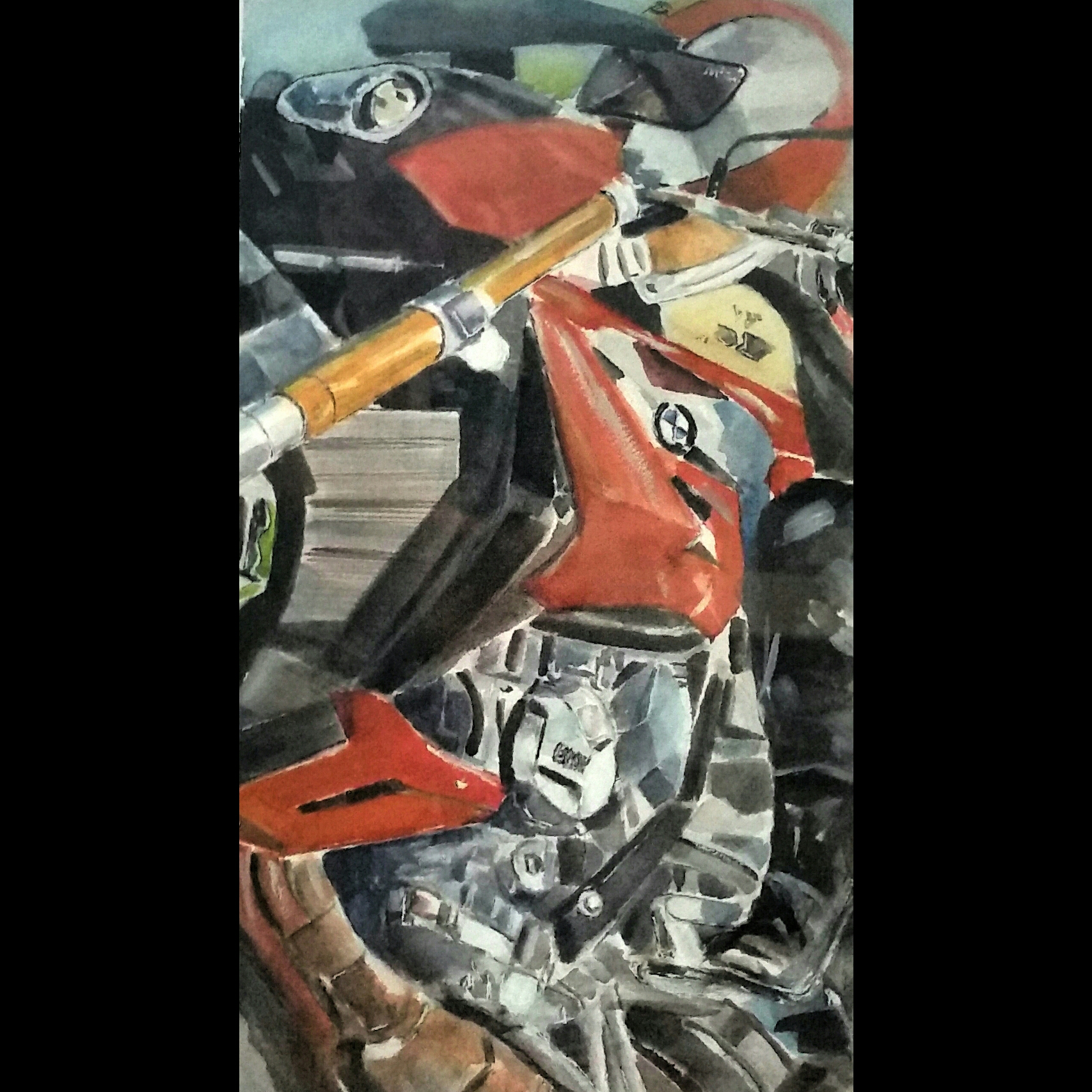
The gallery's warehouse was adjacent to its exhibition rooms and the only point of entry for future exhibits. In one corner, along with various pieces of instillation art, crates containing sculptures, and numerous paintings, stood a life-sized motorcycle, with the number 65 displayed on each side. Throughout the year the gallery held exhibitions and competitions, all attracting considerable interest from the art world and thousands, literally, of visitors from the general public. Art and culture are always a major draw in any city centre.

“It's a wonderful piece", the professor said, staring at the motorcycle. "Look at the detail the artist has achieved, while still maintaining a blurry, edgy feel; the raw essence of period, power, decline. It's...” The professor’s hands were upturned like a couple of stricken crabs, shaking as he struggled to find his point.

“Absolutely, the work sums up the macho, metaphysically organic dominance associated with motorcycles, while showing the abstract creativity where mechanisms meet art. An almost objective feminine beauty juxtaposes with subjective function. Perfume mingled with testosterone.” Daphne, one of the judges, was oozing enthusiasm and appreciation for the work.

“I assume the title will actually be, Norton”. The professor said. “It is after all plastered all over the work, and, I think, significant in an illustrative way. And clever. The humour of it, eh, the humour.” He was chuckling now, giggling almost, tutting and raising his eyes as if sharing some coquettish secret.

“It's the flux of pluralism that I see”, the professor continued. “Almost Bergosian. What the eye meets is the most significant, not the considered afterthought”

“Yes”, Daphne joined. “That was the thrust of my doctorate”.

“Norton is almost playful in its treatment of the monolith of modernism” the professor went on. “I love the humour of its apparent practicality”.

“Yes, yes”, Daphne said. “One could actually imagine riding it. Brilliant. The casting of shadows over so many images of the past. Great imagination, and talent”.

The professor was in complete agreement. “Do you think it represents an opening into other spaces. The generosity and receptiveness of the 60s. The concept of travel, love, thrill?”

“Yes, but still with a sense of the self critical, of sadness. Look at the blueing on the those pipes. And the number, 65”.

“Ah”. The professor had seen the line of Daphne's argument. “The war in Vietnam”, he said. “Capitalist industrial might and arrogance ”.

“And Che Guevara, a motorcyclist himself, I believe, resigned from Castro's government in that year”. Daphne said. “Norton has been created as a biography, a veil over recent history revealing a narrative of the abstractive nature of post-modernism. There's a trajectory over the dialectic nature of the work that necessitates rapture in its organic preoccupation.”

“Mm”. The professor was stroking his chin. “It represents a significant work. We sometimes find ourselves repudiating the hubris of reputation. Here, Norton is showing the decaying past in a present function. It has established facets that can commute, switches and adjustments that mean each time it is exhibited it could quite feasibly change in appearance, no two exhibitions will be exactly the same. The allegorical metaphor the artist has created is breathtaking”.

“Astonishing. It'll probably win this year by a mile”, Daphne said. “Have you seen the others? Oil and watercolours, portraits and landscapes. Hideous installations and sculptures. Ugh!”

And with that they stood looking at Norton, imagining the delight of the other judges when they first set eyes on the piece, meeting the artist, quaffing champaign and oysters, wine and salmon, and generally talking about the quintessential meaning of art. 

But then they both noticed a shutter rolling up in the corner of the warehouse, as a figure walked in. Strolling slowly towards Norton, the figure was gradually revealed from the burst of bright sunlight that had enveloped it. Clothed in jeans and leather, head and face covered in a black helmet, goggles and scarf, the figure mounted Norton and kicked over the engine with a continuous flow of the body. Norton came to life and disappeared through the open shutter. "Sensational", said Daphne. "Outstanding", said the Professor.